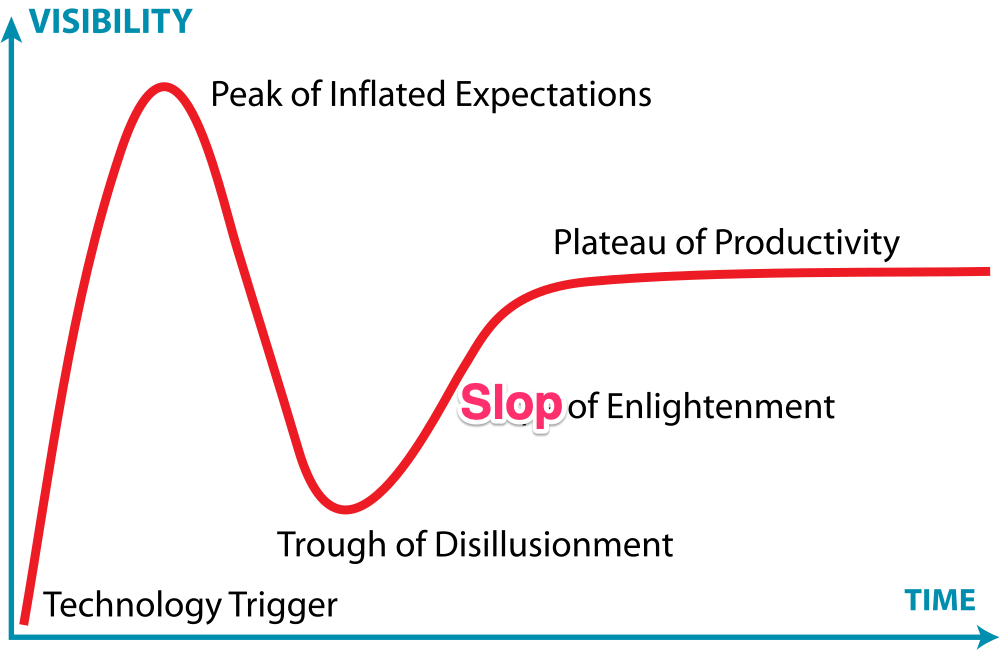
Working in technology in your mid forties feels scary. This is an account mostly for myself, as a diary entry.
Early to Mid 2025: Feeling Behind 🔗
2025 was a weird year for most coders. I felt it somewhat at my day job, but more so in my personal open source work. That’s where my identity as a coder really lives, for whatever reason. It’s the stuff I do when no one needs me to do it.
I had been working on my Ruby compiler for 5+ years, and all of a sudden, it looked like the world was about to explode with better and more software thanks to AI.
It’s hard to put into words, but my work felt redundant, or I felt redundant maybe. I don’t think it was even logical – it was just self-inflicted FUD.
X was full of people saying “this changes everything” and “the sky is falling” and I just… breathed it all in. I felt left behind. Coworkers were talking about this model and that model, this and that coding harness, and something about context windows and effort level and tokens.
Meanwhile I hadn’t gone beyond Copilot autocomplete in my editor. As a 44-year-old programmer, I had a moment where I thought This is it. This is the spot where the young kids overtake me. This is my COBOL moment.1
How did I lose the plot so quickly? I panicked.
I started using Claude Code at work, naturally, because they pay me to ship features and fix bugs – stuff with real customer impact – not to type code on a keyboard.
But I took a break from the Ruby compiler project because I couldn’t figure out how AI could fit into open source. Like, am I really going to pay Anthropic or OpenAI to write code for me, for a project I do for fun?
Late 2025: Facing My Fears with RagChew 🔗
My employer provides a one-month sabbatical every 5 years, and mine happened to be due in late 2025, so I took the time off and faced my fears. If this technology is going to be the death of the dinosaur programmer, then I might as well understand it and consciously choose my fate. Rather than let it pass over me, I decided to face it head on.
That month, in addition to getting outside more and going on walks, I worked on my ham radio website using Claude Code. It’s an app I enjoy building, but it’s just a useful tool and not something I have high engineering standards for. It’s fine if it’s a little messy, as long as it works. Felt like a good candidate for AI.
And, it was ok. Claude definitely took some shortcuts and made mistakes, but I learned to recognize those and correct it. I won’t get too into this because my story learning to use AI is not unlike many others. But I was able to add several new features that I wouldn’t have tackled on my own.
I didn’t hate it. It was different and weird, but it felt productive. And, most important, the hype FUD I felt earlier started to dissipate. By the end of that month, I went back to work seeing at as a tool instead of the harbinger of doom.
2026: Embracing the Vibe with Cora 🔗
That year was a roller coaster! I came to terms with using AI at work (they pay me to do ship stuff) and even using AI for side projects (for tools I just want to work and not spend a lot of time on).
But that still left my passion project: Natalie. I just couldn’t decide if I should use AI, write code by hand, or do some hybrid. How do you do remain a craftsman in this new world?
…
So I did something insane: I swung the pendulum all the way to the other side and decided to build a new Ruby interpreter fully with AI. Embrace the slop. Write practically zero code myself.
I was hesitant to introduce AI slop into my 5-year passion project, so I’d build a new project where it didn’t matter.
Guess what happened? I still had fun. But it was a different kind of fun.
I just leaned into the absurdity of vibe coding. Code nothing. Tell the AI to do everything.
But I found even with this mentality I couldn’t fully turn off my engineering brain. I still reviewed the architecture. I still refactored messy parts. I rejected working features that would make future changes harder.
This was the most suprising part. I thought that becoming a vibe coder would make me lazy. And maybe it did a little, but not to the extent that I feared. I still care about architecture! It’s possible to use AI to write code and still care about that code.
I’ll write about Cora soon on this blog. Briefly, as of today Cora is messier than Natalie in terms of code quality and architecture, but it also outperforms and is a more complete Ruby implementation than Natalie. Take that for what you will.
It’s an experiment, and I don’t care if it ever succeeds at anything. The Cora project helped me learn about:
- Frontier models like GPT-5.4 and Opus 4.7
- Open weights models like GLM, MiniMax, and DeepSeek.
- Ralph Wiggum loops
I most important, I came to a conclusion…
Lessons 🔗
I think the conclusion of this story is that I’m personally ready to use AI in my open source work. I’ve used it at work when people pay me to get crap done, I’ve used it on the personal tools where code quality was less of a concern, and I’ve even taken on the personality of a vibe coder. And now I know where I fit in.
I’ll use AI where it makes sense, and I’ll type out the rest. I’ll be cautiously introducing some AI coding into my 5-year passion project, and I won’t feel like I’m betraying who I am.
I’m still a coder.